
Short answer: A smoke tester for cars is worth considering when a suspected intake or exhaust leak remains invisible after basic checks. The C4 Automotive Smoke Leak Detector is documented for vehicle leak-diagnostic work, with engine intake and exhaust system checks named on the current product page. It is the English Version configuration and smoke oil is not included. That gives you a clear purchase boundary: use it when the job is to make a possible leak path visible, and verify the vehicle-specific connection method before ordering. Do not treat a smoke tester as a universal answer to warning lights, emissions results or every engine fault.
Separate a smoke check from a parts guess
Drivers often reach for a smoke tester after a warning light, rough idle, hesitation, hissing sound or exhaust noise has resisted a quick visual inspection. Those symptoms can justify a leak investigation, but they should not be converted into a confident diagnosis before the system has been checked.
The value of smoke is visibility. It can help show where to focus the next inspection. If the real problem is a sensor signal, fuel pressure, ignition, software or internal engine damage, a smoke tester may add cost without answering the important question.
| Buying signal | What the tool may help with | Boundary |
|---|---|---|
| Suspected intake leak | Make an escape point easier to inspect | Follow the exact vehicle procedure |
| Suspected exhaust leak | Focus attention on a joint or section | It does not certify emissions or MOT status |
| General engine fault | Often too broad | Choose a method matched to the fault |
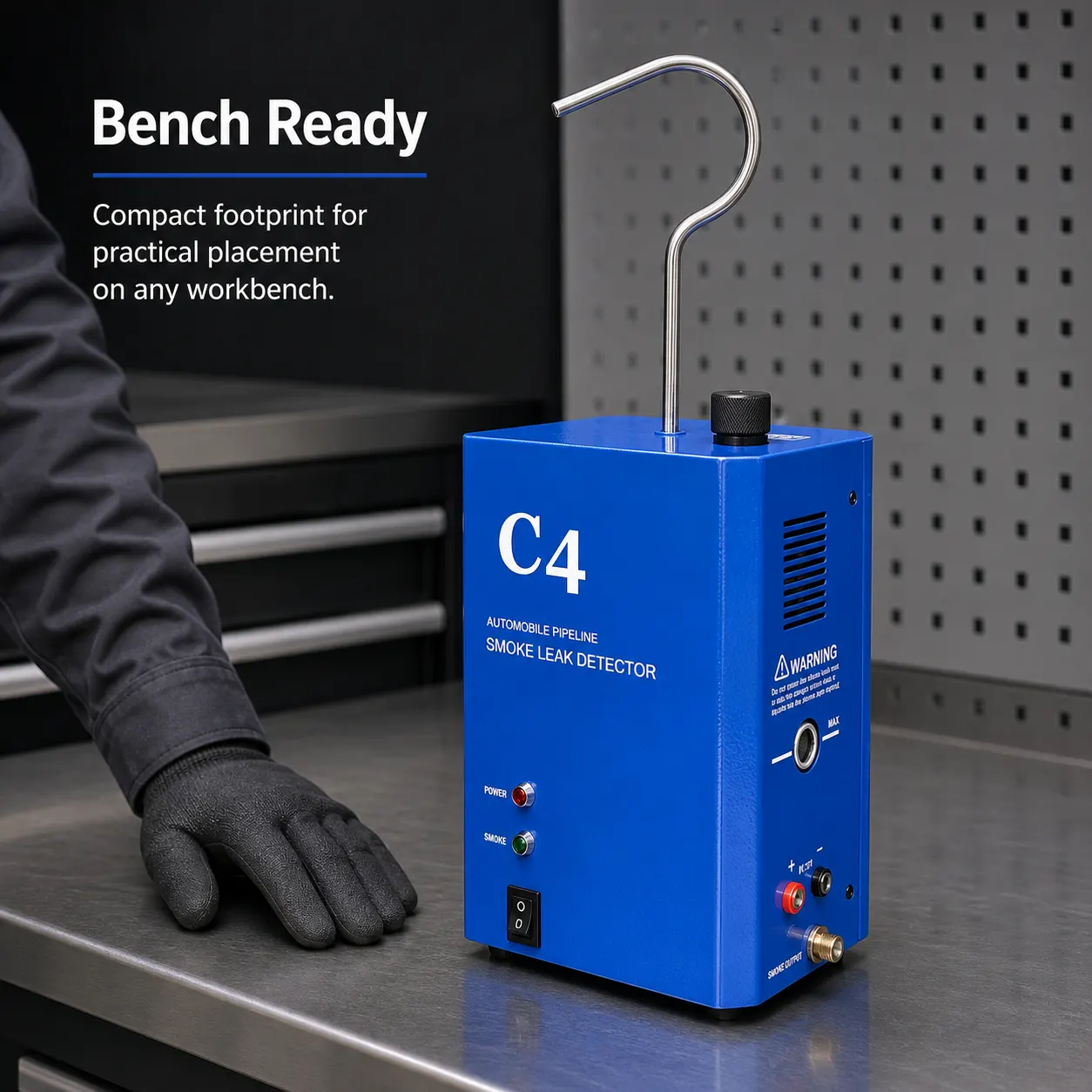
Check what the C4 page actually says
The current listing names the C4 Automotive Smoke Leak Detector - English Version and positions it for vehicle leak-diagnostic work. It specifically identifies engine intake and exhaust system checks. It also makes the practical package point that smoke oil is not supplied.
That is enough to assess the broad use case, but not enough to invent a complete workshop specification. The page does not document universal car fitment, adapters, pressure range, certification or a step-by-step procedure for every engine layout. Manufacturer does not specify those details.
- Name the symptom and the suspected leak system.
- Check the vehicle service information for a suitable test method.
- Confirm the required connection points and isolation steps.
- Buy smoke oil separately if the chosen procedure requires it.
- Use the observation to guide inspection, then verify the repair independently.
Keep the garage boundary visible
HSE guidance covers health and safety in motor vehicle repair, including hazards that remain present during ordinary diagnostic work. A smoke tester does not make a hot engine, fuel system, lifted vehicle or poorly ventilated space safe by itself.
For a driveway job, work only within your competence and the vehicle information available to you. For a small workshop, keep risk controls and staff training separate from the product's marketing description. The C4 page's low-pressure and vehicle-specific wording is a limit to respect, not a missing number to guess.
Who should buy and who should pause
The C4 is a plausible choice for a driver or mechanic who regularly needs to inspect suspected intake or exhaust leaks and is comfortable preparing the vehicle correctly. The English labelling may reduce friction during setup, while the smoke-oil exclusion simply needs to be planned for.
Pause if you expect a complete professional case, a universal adapter system, a known pressure range or a guaranteed repair result. A careful buyer gets more value from a modest tool used for a well-defined question than from a broad claim that the listing does not support.
Related guides and product details
Buy the C4 for a defined automotive leak check, not for the promise of a complete engine diagnosis, and plan the missing consumable before the job. Read Car Smoke Leak Detector UK: What to Check Before Buying for related guidance. Read Engine Smoke Leak Tester: When It Helps Before More Parts for related guidance. Review the documented specification on the C4 Automotive Smoke Leak Detector - English Version product page before ordering.
Sources and safety context
- Supports the exact C4 configuration, automotive use, intake and exhaust scope and smoke-oil exclusion. Current Cupeohome product page.
- Supports the need to treat vehicle repair and diagnostic work as a safety-controlled activity. HSE: Motor vehicle repair.